Retirement taxes in NY, NJ and CT
By the Filoah team · Last checked November 21, 2026 · Rules as of the 2026 tax year
The short answer
New York and New Jersey do not tax Social Security, and Connecticut does not tax it when federal adjusted gross income is under $75,000 (single) or $100,000 (married filing jointly). All three give breaks on pensions and IRA withdrawals. Each draws its lines differently: New York by age and a $20,000 cap per person, New Jersey by age and total income, and Connecticut by income alone.
The three states side by side (2026 rules)
| New York | New Jersey | Connecticut | |
|---|---|---|---|
| Social Security | Not taxed | Not taxed | Not taxed under federal AGI of $75,000 single or $100,000 joint; partly taxed above |
| Government pensions | NY State, NY local and federal pensions not taxed | Counted in the pension exclusion; U.S. military pensions not taxed | Counted in the pension subtraction; military retirement pay not taxed |
| Private pensions, 401(k), IRA | Up to $20,000 per person not taxed, from age 59 and a half | Up to $100,000 joint ($75,000 single) not taxed, from age 62, if total income is $100,000 or less; a share up to $150,000 | All of it subtracted under federal AGI of $75,000 single or $100,000 joint; shrinks to none at $100,000 or $150,000 |
| Age test for that break | 59 and a half | 62 (or disabled under Social Security rules) | None |
| 2026 tax rates | 3.9% to 10.9% | 1.4% to 10.75% | 2% to 6.99% |
| Local income tax | New York City and Yonkers | None | None |
Each state has its own page with more detail and a worked example:
New York
New York does not tax Social Security. It also does not tax pensions from New York State, its local governments, or the federal government, including military pensions.
Other retirement income gets a smaller break. From age 59 and a half, each person can leave out up to $20,000 a year of private pensions, annuities and IRA or 401(k) withdrawals. The $20,000 is per person. One spouse cannot use the other's unused part.
New York's 2026 rates run from 3.9 percent to 10.9 percent. The standard deduction is $8,000 for a single filer and $16,050 for a joint return. Once New York adjusted gross income passes $107,650, New York starts taking back the benefit of its lower brackets. So the top rate you reach can apply to more of your income than the bracket table suggests.
People who live in New York City also pay the city's resident income tax. Its 2026 rates run from 3.078 percent to 3.876 percent.
New Jersey
New Jersey does not tax Social Security or U.S. military pensions.
Its pension exclusion is large but has hard edges. It needs you or your spouse to be 62 or older, or disabled under Social Security rules, on the last day of the year. Then:
- If total income is $100,000 or less, you can leave out up to $100,000 of pensions, annuities and IRA withdrawals on a joint return, $75,000 single or head of household, and $50,000 married filing separately.
- If total income is between $100,000 and $150,000, you can leave out only a share.
- If total income is over $150,000, the exclusion is gone.
A Roth conversion or a large IRA withdrawal counts toward that income. One extra dollar over a line can cost a lot of the exclusion.
New Jersey has no standard deduction. It uses $1,000 personal exemptions, with another $1,000 for each filer 65 or older. Its 2026 rates run from 1.4 percent to 10.75 percent.
Connecticut
Connecticut's retirement breaks depend on income, not age.
- Social Security. Not taxed when federal adjusted gross income is under $75,000 for a single filer or married filing separately, or under $100,000 for a joint return, qualifying surviving spouse or head of household. Above that, part can be taxed.
- Pensions, annuities, 401(k) and IRA withdrawals. Under federal AGI of $75,000 (single, separate, or head of household) or $100,000 (joint), all of it is subtracted. Above that, the subtraction shrinks in steps until it is gone at $100,000 or $150,000. From 2026, traditional IRA withdrawals count in full. In 2025 only 75 percent did.
There is no age test for these breaks. Connecticut's rates run from 2 percent to 6.99 percent. There is no standard deduction, and the personal exemption phases out as income rises.
What the three have in common
- Roth withdrawals. A qualified Roth IRA withdrawal is not in federal adjusted gross income, so none of the three taxes it.
- Income lines matter. In New Jersey and Connecticut, a big IRA withdrawal, a capital gain or a Roth conversion can push income past a line and take away part of a break on other income.
- Required withdrawals count. Required minimum distributions are IRA income, so they use up New York's $20,000 and count toward New Jersey's and Connecticut's income lines.
How Filoah figures state tax
Filoah estimates New York, New Jersey and Connecticut income tax for every year of a plan. Filoah uses its 2026 tax rules. It applies each state's Social Security rules, New York's $20,000 break, New Jersey's exclusion with its age and income tests, Connecticut's pension and IRA step table, and New York City's resident tax for a plan that lives there. Filoah's 2026 rules count a Roth conversion toward New York's $20,000 break.
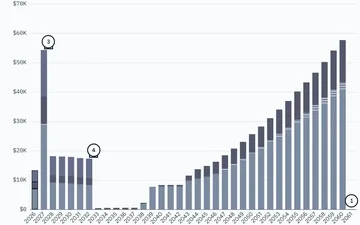
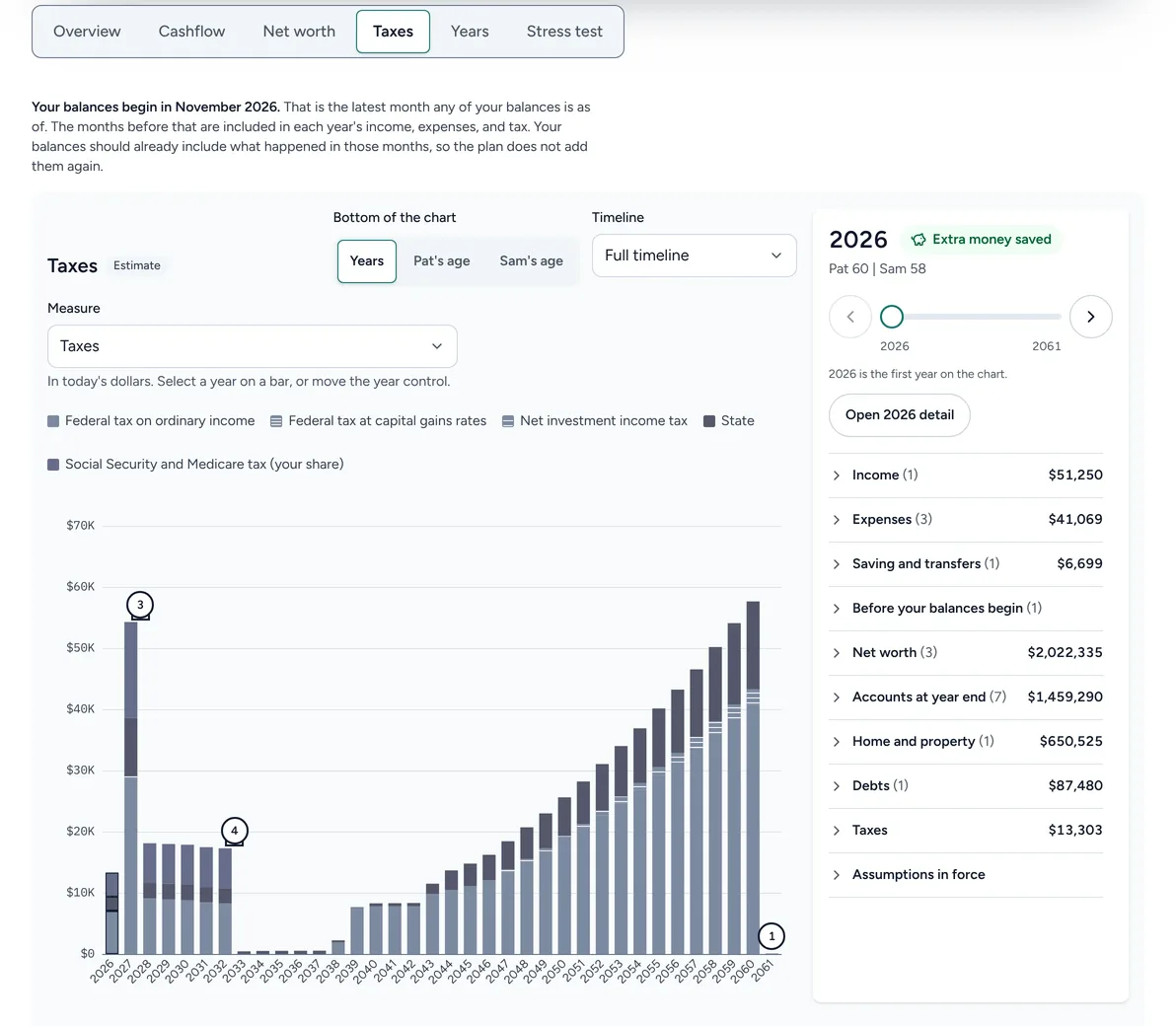
The sample couple in this picture lives in New Jersey. Your own plan shows the state you live in.
If your plan has a move to another state, see Moving to another state in retirement.
What this does not include
- Local income taxes other than New York City's. Filoah does not estimate Yonkers' tax.
- Property taxes and the New Jersey property tax deduction or credit.
- New Jersey's extra exclusion for people 62 or older with little pay from work, and the part of a pension or IRA payment you already paid New Jersey tax on.
- New York's tax tables for lower incomes. Filoah uses the rate schedule.
- New York's break for pensions from New York State, a New York local government or the federal government, including military retirement pay, and for Railroad Retirement. Filoah cannot tell if a pension is one of these, so it taxes it like other pensions. That can show more tax than you owe.
- Connecticut's breaks for a teacher's pension, military retirement pay and Railroad Retirement. Filoah taxes them like other pensions, which can show more tax than you owe.
- Whether a Roth conversion counts toward New Jersey's exclusion and Connecticut's pension and IRA break. Neither state has said. Filoah lets a conversion use both, which can show less tax than you owe.
- Some credits each state offers. Each state page lists what Filoah leaves out.
This page explains how the three states tax retirement income. It is educational only. Results in a plan are estimates, not promises.
Sources
- New York State, Instructions for Form IT-201 (2025)
- New York State, Instructions for Form IT-2105 (2026 estimated tax)
- New Jersey Division of Taxation, GIT-1 and GIT-2, Retirement Income
- New Jersey Division of Taxation, Retirement Income Exclusions
- New Jersey, Instructions for Form NJ-1040 (2025)
- Connecticut DRS, Form CT-1040 Instructions (2025)
- Connecticut DRS, Form CT-1040ES (2026)
Sources checked November 21, 2026.
Run this on your own plan.
Make a free plan with your accounts, your Social Security and your state’s taxes.
Free account. No card. No bank linking.
This article is for learning. It is not tax, legal or investment advice.