Which account to spend from first in retirement
By the Filoah team · Last checked November 21, 2026 · Rules as of the 2026 tax year
The short answer
There is no single right order for spending from your accounts in retirement, because each kind of account is taxed differently when money comes out. A common starting point is taxable accounts first, then tax-deferred, then tax-free. But the order that means less tax over your whole retirement depends on your income each year, your age, and the rules tied to that income.
The three kinds of accounts
Most savings fall into one of three groups. Each is taxed in its own way when you take money out.
- Taxable accounts. A regular brokerage account, a savings account, or cash. When you sell investments, only the gain is taxed. The gain is the sale price minus what you paid, which is called your basis. Long-term gains often get lower tax rates than wages.
- Tax-deferred accounts. A traditional IRA, 401(k) or 403(b). Every dollar you take out is taxed as ordinary income, like wages.
- Tax-free accounts. A Roth IRA, a Roth 401(k), and a health savings account (HSA) used for medical costs. Qualified withdrawals are not taxed at all.
Why the order matters
Your tax each year depends on your income that year. The order you pull from accounts decides what kind of income shows up, and how much.
A made-up example. A couple needs $40,000 of spending money in 2026.
- If they sell $40,000 of fund shares they bought for $30,000, only the $10,000 gain is taxable. For 2026, long-term gains are taxed at 0 percent on a joint return when taxable income is up to $98,900.
- If they take $40,000 from a traditional IRA, all $40,000 counts as ordinary income.
Same cash. Very different tax that year.
The common order: taxable, then tax-deferred, then tax-free
The idea is simple. Spend the money that costs the least tax to reach first. Let the tax-deferred and tax-free accounts keep growing without yearly tax.
What it can miss:
- Tax-deferred accounts keep growing while you leave them alone. Then required minimum distributions start, at 73 or 75 depending on your birth year. Large RMDs can push you into higher brackets later.
- The early years of retirement can have very low taxable income. Low brackets in those years go unused.
Other orders people look at
- Filling low brackets. Take some money from tax-deferred accounts in low-income years, up to the top of a lower bracket, and the rest from taxable accounts. This can shrink the tax-deferred balance before RMDs start. Some people do the same with a Roth conversion instead of spending the money.
- A mix each year. Take a share from each kind of account every year, so taxable income stays more even.
- Keeping the Roth for last. A Roth IRA has no RMDs for its owner. Some people keep it for late life, large one-time costs, or heirs.
None of these is best for everyone. Which one leads to less tax depends on your numbers.
Rules that change the answer
- RMDs come first. Once they start, the RMD must come out each year, whatever order you prefer.
- The 10 percent early tax. Most withdrawals from a traditional IRA, 401(k) or 403(b) before age 59 and a half carry a 10 percent additional tax, unless an exception applies.
- Roth rules. Roth earnings come out tax free once the account is 5 years old and you are 59 and a half or older. A few other cases count too. Contributions can come out tax free.
- HSA rules. HSA money for qualified medical costs is tax free. For anything else it is taxed, with a 20 percent extra tax before 65.
- Social Security tax. More taxable income can make more of your Social Security taxable (provisional income).
- Medicare premiums. Higher income can raise Medicare premiums two years later (IRMAA).
- Heirs. Investments in a taxable account generally get a new basis equal to their value when the owner dies (step-up in basis). Heirs of a traditional IRA pay income tax on what they take out.
How Filoah shows your order
When cash runs short in a plan, Filoah takes money from your accounts in an order. By default, Filoah puts taxable accounts first, then tax-deferred, then tax-free. Any RMD for the year is taken first, and that money pays spending before the order is used.
The Withdrawal order panel lists the accounts in the order the plan uses. Each account has a small chart with one bar for each year money comes out of it. A striped bar means the money comes out before age 59 and a half, when an extra tax can apply.
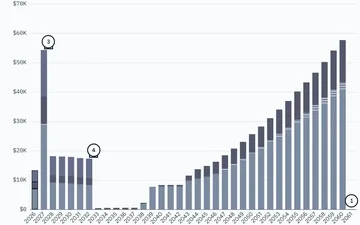
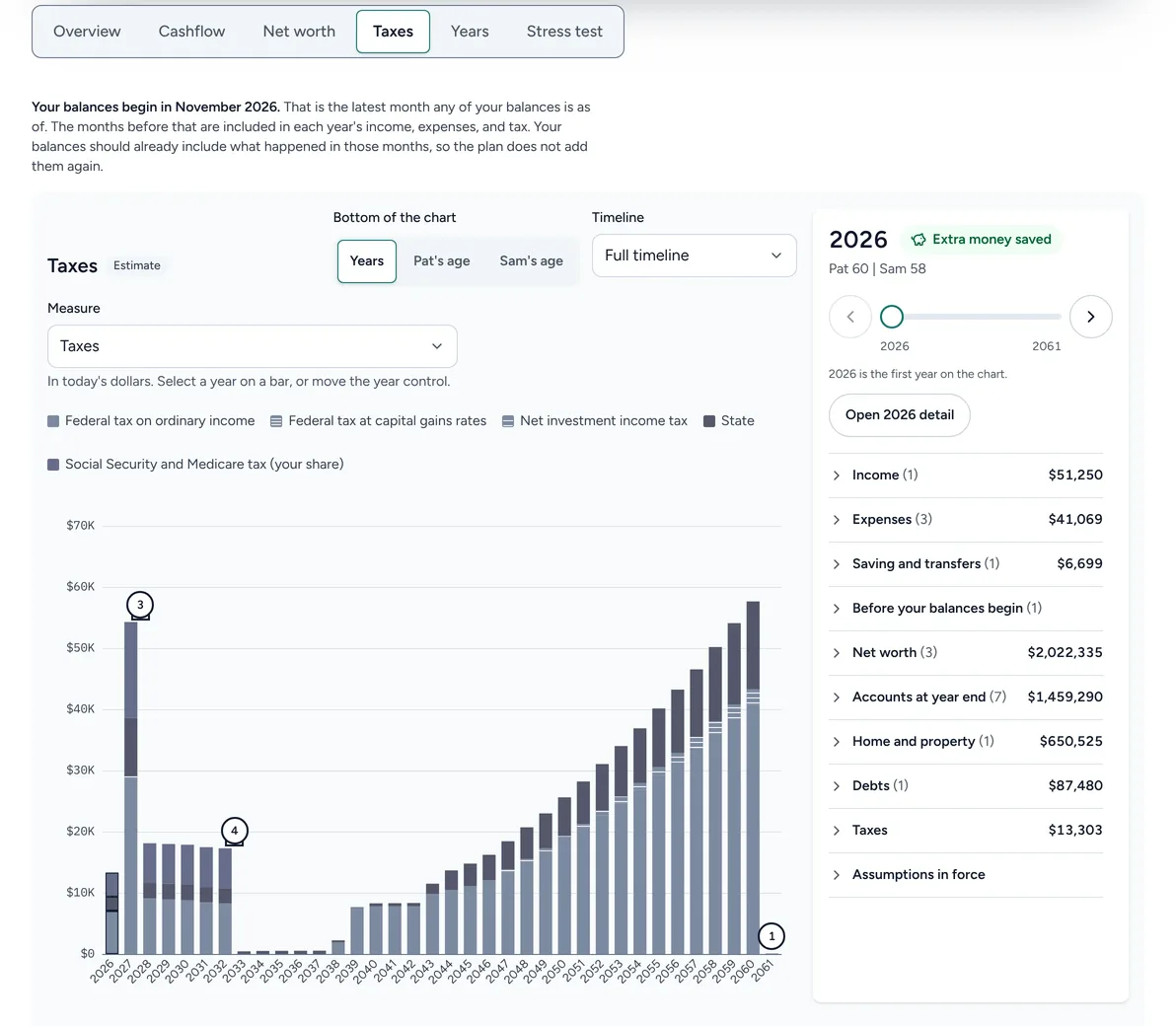
The Taxes view shows each year's estimated tax, so you can see what that order does to your income and tax year by year.
What this does not include
- A search for the order with the lowest tax. Filoah runs the order the plan has. It does not pick one.
- The step-up in basis after a death. Filoah keeps the basis you entered, which can show more tax than an heir would really owe.
- Tax-loss harvesting and the choice of which shares to sell.
- Tax held back by the account company when money comes out.
- Exceptions to the 10 percent early tax. Filoah adds it for a traditional IRA, 401(k) or 403(b) and shows a plan check that names the common exceptions.
This page explains how withdrawals are taxed. It is educational only and does not say which order to use. Results in a plan are estimates, not promises.
Sources
- IRS Revenue Procedure 2025-32 (2026 tax brackets, capital gains rates, standard deduction)
- IRS Topic no. 409, Capital gains and losses
- IRS Publication 551, Basis of Assets
- IRS Publication 590-B, Distributions from Individual Retirement Arrangements (IRAs)
- IRS Publication 969, Health Savings Accounts and Other Tax-Favored Health Plans
Sources checked November 21, 2026.
Run this on your own plan.
Make a free plan with your accounts, your Social Security and your state’s taxes.
Free account. No card. No bank linking.
This article is for learning. It is not tax, legal or investment advice.