Required minimum distributions, explained
By the Filoah team · Last checked November 21, 2026 · Rules as of the 2026 tax year
The short answer
A required minimum distribution (RMD) is money the law makes you take out of a traditional IRA, 401(k), 403(b) and similar accounts each year once you reach a set age. For people born from 1951 to 1958 that age is 73, and for people born in 1960 or later it is 75. For people born in 1959, the IRS has proposed 73 in rules that are not final yet. The yearly amount is last year's ending balance divided by a number from an IRS table.
What an RMD is
Money in a traditional IRA or 401(k) went in before tax, or grew without tax. The government wants that tax at some point. So once you reach the start age, you must take out at least a minimum amount every year. That minimum is the required minimum distribution.
You can always take out more. You cannot take out less without a penalty.
When RMDs start
The start age depends on the year you were born.
| Born | RMDs start at |
|---|---|
| Before July 1, 1949 | 70 and a half |
| July 1, 1949 to 1950 | 72 |
| 1951 to 1958 | 73 |
| 1959 | 73 (see below) |
| 1960 or later | 75 |
The law for people born in 1959 reads two ways, 73 and 75. The final IRS rules leave that year open. The IRS has proposed 73 in rules that are not final yet, and Filoah uses 73 for 1959.
Your first RMD is for the year you reach the start age. The IRS lets that first one wait until April 1 of the next year. If it waits, two RMDs come out in that next year: the late first one and that year's own. Two in one year means more income in that year.
How the yearly amount is figured
The math has two parts.
- Take the account balance on December 31 of the year before.
- Divide it by a number for your age this year. The number comes from the IRS Uniform Lifetime Table.
The number gets smaller as you get older. So the share you must take out gets bigger each year.
A made-up example. Someone turns 73 in 2026. Their traditional IRA held $500,000 on December 31, 2025. The table number at 73 is 26.5. Their 2026 RMD is $500,000 divided by 26.5, which is $18,867.92. If the balance were the same at 75, the number would be 24.6, and the RMD would be $20,325.20.
There is one more table. If your only beneficiary is a spouse more than 10 years younger than you, a different IRS table (the Joint and Last Survivor Table) is used. It gives a smaller RMD.
Which accounts have RMDs
- Have RMDs: traditional IRAs, SEP and SIMPLE IRAs, 401(k), 403(b), and most other work plans, while the owner is alive.
- No RMDs while the owner is alive: Roth IRAs, and Roth 401(k) and Roth 403(b) accounts.
- Different rules: an inherited IRA. See Inherited IRAs and the 10-year rule.
If you still work, a 401(k) or 403(b) at your current job may let you wait until you retire, if the plan allows it. This does not work for someone who owns more than 5 percent of the company. It never works for an IRA.
How RMDs are taxed
An RMD from a traditional account counts as ordinary income. It is taxed in the year you take it, at your regular tax rates. It adds to your adjusted gross income (AGI).
A bigger AGI can do more than raise your income tax. It can make more of your Social Security taxable. It can also raise your Medicare premiums two years later, through the income-related monthly adjustment amount (IRMAA), which looks at your tax return from two years before.
An RMD cannot be moved into a Roth IRA as a conversion, and it cannot be rolled over. The RMD for the year comes out first. Only money above it can be converted.
Some people send money from an IRA straight to a charity. This is a qualified charitable distribution. It must go directly from the IRA to the charity, and the owner must be at least 70 and a half. Up to a yearly limit, the IRS does not count it as income.
What happens if you miss one
If you take out less than the RMD, the IRS can charge an excise tax of 25 percent of the amount you missed. If you fix it in time, within two years, the tax can drop to 10 percent. It is reported on IRS Form 5329.
Taking more than the minimum in one year does not lower next year's RMD. Each year stands on its own.
How Filoah shows RMDs
In a free Filoah plan, each traditional IRA, 401(k) or 403(b) row says the age its required withdrawals start. When the plan reaches that age, Filoah takes the RMD each year, in equal monthly parts, and taxes it as income. That money pays your spending first, before the plan takes anything else from your accounts.
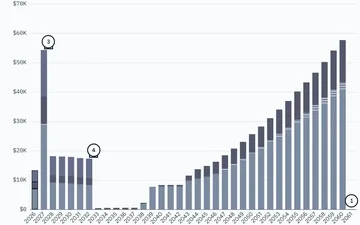
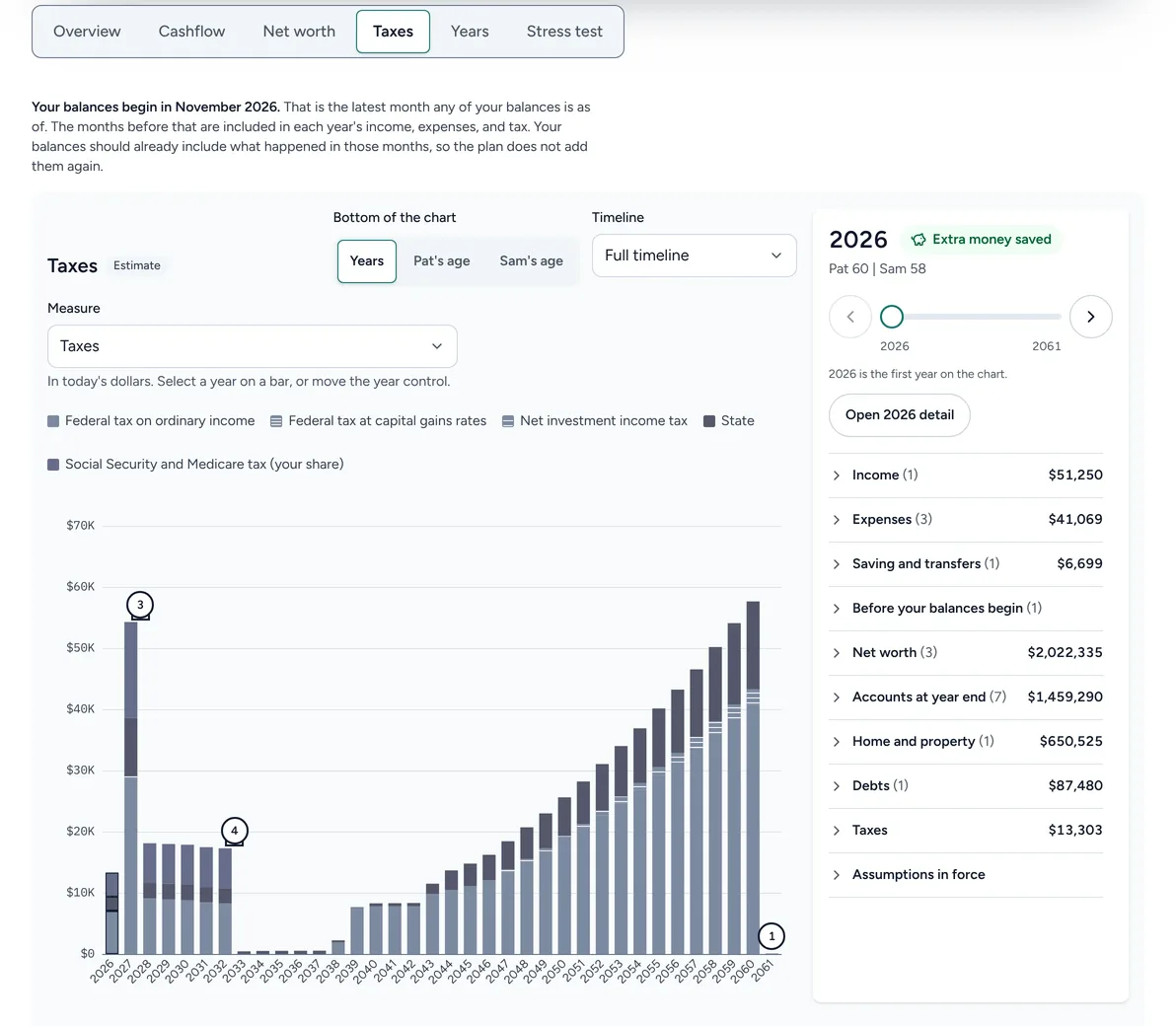
The Taxes view shows each year's estimated tax, with the RMDs counted in it, so you can see the years when RMDs push your tax up.
Filoah takes the first RMD in the year you reach the start age. It does not use the April 1 wait. A plan check says so.
What this does not include
- The April 1 wait for the first RMD. Filoah takes it in the first year.
- The smaller RMD when a spouse more than 10 years younger is the only beneficiary. Filoah uses the Uniform Lifetime Table and shows a plan check when the other person in the plan is more than 10 years younger.
- The wait while you still work at the job a 401(k) or 403(b) comes from. A plan check says this may apply.
- Qualified charitable distributions.
- The excise tax for a missed RMD. Filoah always takes the full amount.
- Whether a plan put under "Other" truly has an RMD. Filoah takes one from a tax-deferred Other account, and says some accounts of that kind have none.
This page explains how the rules work. It is educational only. Results in a plan are estimates, not promises.
Sources
- IRS Publication 590-B, Distributions from Individual Retirement Arrangements (IRAs)
- IRS, Retirement plan and IRA required minimum distributions FAQs
- IRS, Retirement topics: Required minimum distributions (RMDs)
Sources checked November 21, 2026.
Run this on your own plan.
Make a free plan with your accounts, your Social Security and your state’s taxes.
Free account. No card. No bank linking.
This article is for learning. It is not tax, legal or investment advice.