Roth conversions before RMDs: the trade-off
By the Filoah team · Last checked November 21, 2026 · Rules as of the 2026 tax year
The short answer
A Roth conversion moves money from a traditional IRA or 401(k) into a Roth account, and you pay income tax on it in the year you move it. Doing this before required minimum distributions start can make those later withdrawals smaller, but it trades a known tax bill now for a tax you may or may not owe later.
What a Roth conversion is
A traditional IRA holds money that has not been taxed yet. A Roth IRA holds money that has. A Roth conversion moves money from the first kind to the second.
The amount you move counts as ordinary income in the year you move it. It is taxed at your regular rates, the same as wages. There is no 10 percent early withdrawal tax on the move itself. But each conversion starts its own 5-year clock. Taking that converted money out of the Roth within 5 years, before age 59 and a half, can bring the 10 percent tax.
Why people look at conversions before RMDs
Required minimum distributions (RMDs) start at 73 for people born from 1951 to 1958, and at 75 for people born in 1960 or later. For people born in 1959, the IRS has proposed 73 in rules that are not final yet. Each RMD is figured from the traditional account's balance. A bigger balance means a bigger RMD, and more taxable income every year.
A Roth IRA has no RMDs while the owner is alive. Neither does a Roth 401(k) or Roth 403(b). So money moved to a Roth before RMDs start is money that RMDs no longer reach.
The years between leaving work and the start of RMDs are often lower-income years. Some people have little taxable income then. That is why this window gets attention.
The trade-off in plain words
A conversion does not make tax go away. It changes when you pay it.
- Pay now. You pay tax this year, at this year's rates, on the amount you move.
- Pay later. If you leave the money where it is, you pay tax later, when RMDs or other withdrawals come out, at the rates of those years.
Which is lower depends on things nobody knows for sure: your future income, future tax law, how long you live, how your investments do, and who inherits the account. A conversion can lower lifetime tax in one plan and raise it in another.
There is one more piece. The tax on a conversion has to be paid from somewhere. Paying it from money outside the IRA leaves more in the Roth. Paying it from the IRA itself shrinks what gets moved.
A made-up example with 2026 numbers
A made-up couple files jointly in 2026. After the standard deduction, their taxable income is $70,000.
For 2026, the federal 12 percent bracket for a joint return runs up to $100,800 of taxable income. So they have $30,800 of room left in the 12 percent bracket ($100,800 minus $70,000).
If they convert $30,800, the added federal income tax is 12 percent of $30,800, which is $3,696. A conversion larger than that would be taxed at 22 percent on the part above $100,800, up to $211,400.
That is the plain bracket math. It leaves out the side effects below, which can raise the real cost.
Side effects that can change the cost
A conversion raises your adjusted gross income (AGI) for the year. Several rules look at that number.
- Social Security tax. How much of your Social Security is taxed depends on half your benefits plus your other income (provisional income). A conversion can push more of your benefits into tax.
- Medicare premiums. Medicare's IRMAA surcharge looks at your tax return from two years before. For 2026 premiums, it starts above $109,000 of modified AGI for a single filer and $218,000 for a joint return. A 2026 conversion can raise premiums in 2028.
- Health insurance before 65. A marketplace premium tax credit depends on income. From 2026 there is no credit above 400 percent of the federal poverty line.
- The senior deduction. For 2025 to 2028, each filer 65 or older can deduct up to $6,000 more. It shrinks by 6 percent of modified AGI over $150,000 on a joint return.
- State tax. States treat conversions differently. New York's $20,000 pension and annuity exclusion at 59 and a half can cover a conversion. In New Jersey, a conversion counts toward the income line that can end the pension exclusion. See Retirement taxes in NY, NJ and CT.
Rules to know
- An RMD cannot be converted. In a year with an RMD, the RMD comes out first. Only money above it can move to a Roth.
- A conversion cannot be undone once made.
- People who inherit a Roth IRA follow the inherited IRA rules, but withdrawals of contributions are tax free, and most withdrawals of earnings are too. See Inherited IRAs and the 10-year rule.
Seeing a conversion in a Filoah plan
In a free Filoah plan, you can add a conversion as a "Move money between accounts" row, from a traditional account to a Roth account. Filoah counts it as income in that year and estimates the federal and state tax. In a year with an RMD, the plan takes the rest of that year's RMD first and says so.
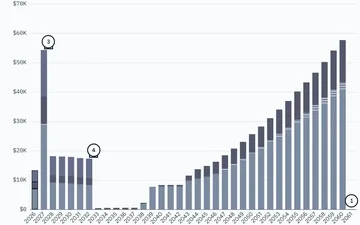
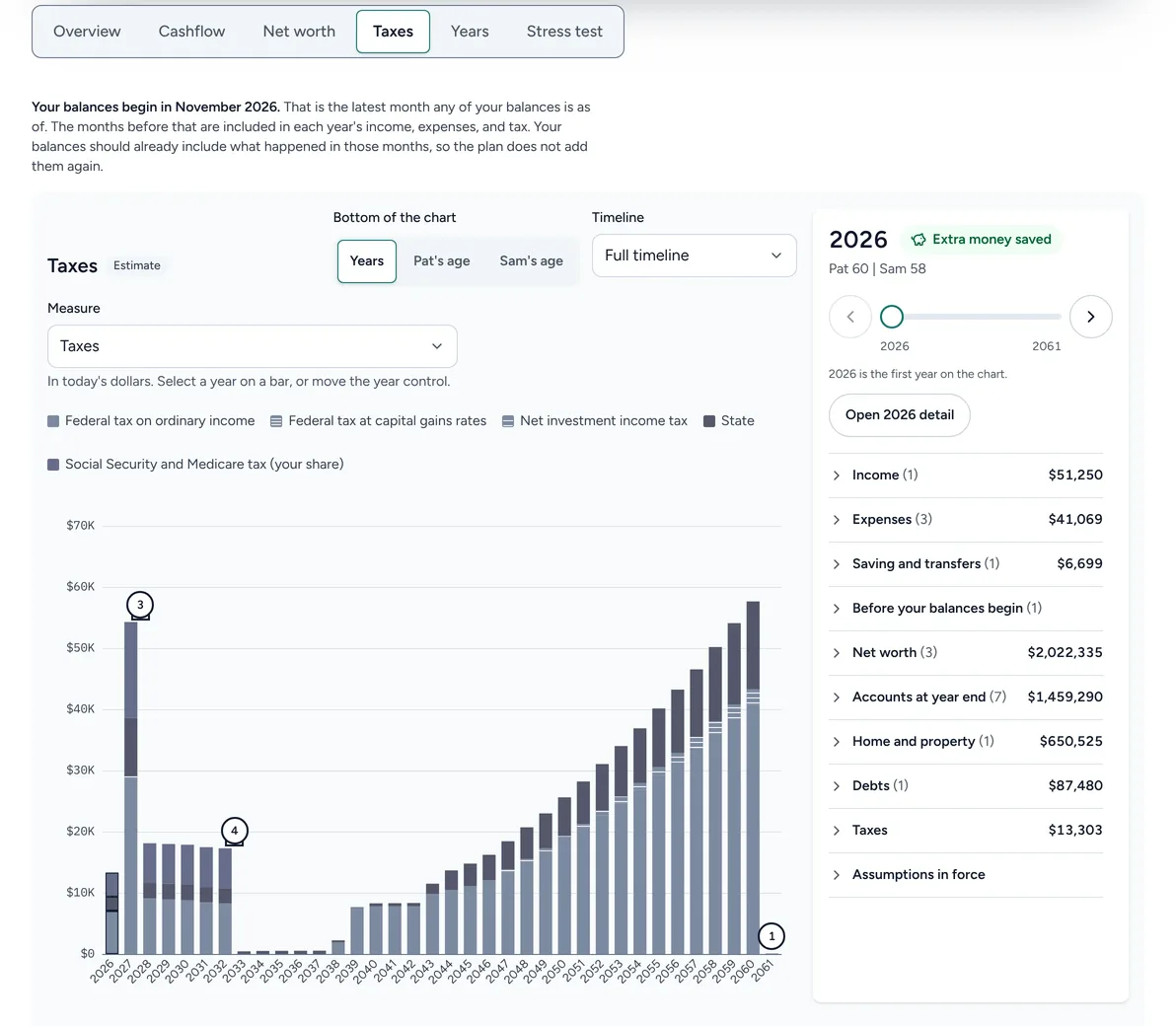
The Taxes view shows each year's estimated tax. The plan's later years include the RMDs it takes, so you can see how a conversion changes them. Filoah does not search for a conversion amount or pick one for you.
What this does not include
- The 5-year rules on converted money in a Roth 401(k) or Roth 403(b). Filoah tracks them only for a Roth IRA with its history entered.
- Which work plans allow a conversion inside the plan. Filoah does not check this.
- Tax held back by the account company, and how the tax bill is paid. Filoah pays the tax from the plan's cash.
- Future changes to tax law. Filoah uses the rules as of the 2026 tax year.
- The heirs' taxes after your death.
This page explains how conversions work. It is educational only and does not tell you whether to convert. Results in a plan are estimates, not promises.
Sources
- IRS Publication 590-A, Contributions to Individual Retirement Arrangements (IRAs)
- IRS Publication 590-B, Distributions from Individual Retirement Arrangements (IRAs)
- IRS Revenue Procedure 2025-32 (2026 tax brackets and standard deduction)
- IRS Publication 915, Social Security and Equivalent Railroad Retirement Benefits
- Medicare Costs (CMS publication 11579)
Sources checked November 21, 2026.
Run this on your own plan.
Make a free plan with your accounts, your Social Security and your state’s taxes.
Free account. No card. No bank linking.
This article is for learning. It is not tax, legal or investment advice.