Health insurance if you retire before 65
By the Filoah team · Last checked November 21, 2026 · Rules as of the 2026 tax year
The short answer
If you retire before 65, you need health coverage until Medicare starts. You have four main choices: COBRA, a marketplace plan, a spouse's job plan, or retiree coverage. On the marketplace, a premium tax credit can lower the price, based on your income. Each choice has its own rules about cost and timing.
Why 65 matters
Medicare starts at 65 for most people. Your first chance to sign up runs from 3 months before the month you turn 65 to 3 months after it. If you sign up late for Medicare Part B, you can pay a penalty for as long as you have it. In 2026 the standard Part B premium is $202.90 a month.
Before 65, Medicare is not there. So a person who stops work at 60 needs five years of other coverage.
Choice 1: COBRA
COBRA is a federal law. It lets you keep the health plan from your old job after you leave, for yourself and your family. It applies when the employer had 20 or more workers and still has a plan.
- You have 60 days to sign up, from the later of the notice or the day your coverage ended.
- It lasts up to 18 months, and longer in some cases.
- The plan can charge the whole premium, the part your employer used to pay too, plus 2%.
COBRA keeps the same plan you had. The trade-off is cost: you now pay the full price. There is no premium tax credit for COBRA.
Choice 2: The marketplace
The Health Insurance Marketplace is where people buy their own plan. You can start at HealthCare.gov.
Losing job coverage when you retire opens a Special Enrollment Period. That is a window outside the yearly Open Enrollment when you can sign up. You have 60 days after losing job coverage.
There is a timing catch with COBRA. If you choose COBRA and then drop it early by choice, outside Open Enrollment, you generally have to wait for the next Open Enrollment to get a marketplace plan. When COBRA runs out, you get a new 60-day window.
The premium tax credit, and the 400% line
The premium tax credit is a tax credit that lowers what you pay for a marketplace plan. It is based on your household income compared with the federal poverty line.
For 2026 coverage, the poverty line is $15,650 for one person and $21,150 for two people. These are the 2025 figures, which is what 2026 plans use.
Two 2026 rules matter a lot for early retirees:
- No credit above 400% of the poverty line. For 2026 coverage, that is $62,600 for one person and $84,600 for two. One dollar over the line, and the credit is gone.
- No limit on paying it back. If you get the credit in advance and your income ends up higher than you said, you pay back the extra when you file your taxes, with no cap.
Below the line, the credit works like this. You are expected to pay a share of your income toward a benchmark plan, the second lowest cost silver plan where you live. The credit pays the rest of that plan's price. In 2026 the share is 9.96% of income for households from 300% to 400% of the poverty line, and lower for lower incomes.
Here is a made-up couple. Their household income is $84,000, about 397% of the poverty line. Their expected share is 9.96% of $84,000, about $8,366 for the year. If their income rose above $84,600, they would get no credit at all.
The income that counts is your adjusted gross income, plus tax-exempt interest, plus any Social Security that is not taxed. Money you take from a traditional IRA counts. So does a Roth conversion. Money from a Roth IRA, taken out under the rules, does not.
Other ways to get covered
- A spouse's job plan, if your spouse still works.
- Retiree coverage from your old employer, if it offers it. While you are enrolled in it, you generally cannot get the premium tax credit. If you drop it by choice, that does not open a Special Enrollment Period.
- Medicaid. In states that expanded it, adults with income up to 138% of the poverty line can generally get Medicaid. (The law says 133%, and a 5% income disregard raises it to 138%.)
Marketplace prices in most states go up with age, so a plan at 63 costs more than the same plan at 55. New York does not price by age.
If you have a health savings account (HSA), its money can pay COBRA premiums and premiums while you get unemployment, without tax.
Putting it in your plan
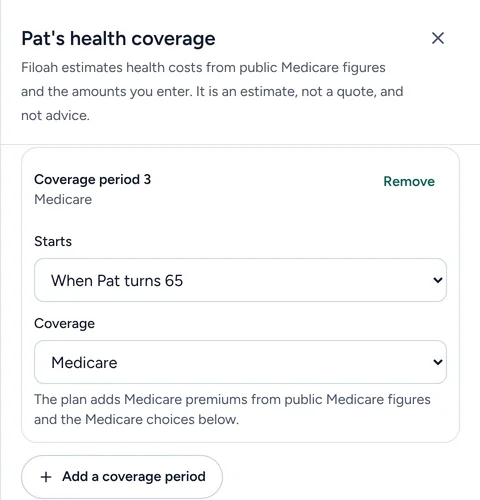
Tell Filoah how each of you is covered, from now to Medicare. It adds Medicare from 65 using public Medicare figures, and puts the cost in each year of your plan. The premium before 65 is a number you type, such as a COBRA quote or a marketplace quote. Until you type it, Filoah counts $0 for it.
What this does not include
- Filoah does not look up or estimate a premium before 65 by itself. It uses the amount you enter.
- It does not choose a plan, a network or a deductible for you.
- It does not check whether you can get Medicaid. It does not model state rules that extend COBRA-like coverage, or state help with premiums.
- It does not include long-term care. Medicare does not pay for most long-term care.
- Rules for the premium tax credit can change. These are the rules for 2026 coverage.
Sources
- HealthCare.gov, Health coverage if you're retiring
- HealthCare.gov, COBRA coverage and the Marketplace
- HealthCare.gov, Special Enrollment Period
- HealthCare.gov, Federal poverty level (FPL)
- IRS, Publication 505 (2026), Tax Withholding and Estimated Tax
- IRS, Revenue Procedure 2025-25 (2026 applicable percentage table)
- Medicare.gov, When can I sign up for Medicare?
- CMS, 2026 Medicare Parts A and B premiums and deductibles
Sources checked November 21, 2026.
Run this on your own plan.
Make a free plan with your accounts, your Social Security and your state’s taxes.
Free account. No card. No bank linking.
This article is for learning. It is not tax, legal or investment advice.