When to take Social Security: 62, full retirement age, 70
By the Filoah team · Last checked November 21, 2026 · Rules as of the 2026 tax year
The short answer
You can start Social Security as early as 62 or as late as 70. Starting early gives you a smaller check for more years. Waiting gives you a bigger check for fewer years. Which is better for you depends on how long you and your spouse live, what else you have to live on, and taxes.
The three ages that matter
Full retirement age is the age when you get your full benefit, with no cut and no bonus. It depends on the year you were born.
| Year you were born | Full retirement age |
|---|---|
| 1955 | 66 and 2 months |
| 1956 | 66 and 4 months |
| 1957 | 66 and 6 months |
| 1958 | 66 and 8 months |
| 1959 | 66 and 10 months |
| 1960 or later | 67 |
62 is the earliest you can start. Your check is cut for each month you start before full retirement age. The cut is 5/9 of 1% a month for the first 36 months early, and 5/12 of 1% for each month past those 36. With a full retirement age of 67, starting at 62 means a check 30% smaller.
70 is the latest age that raises your check. For each month you wait past full retirement age, Social Security adds 2/3 of 1%. That is 8% for each full year. These raises are called delayed retirement credits. They stop at 70.
The cut or the raise usually lasts for life. Each year, the check also gets a cost-of-living adjustment. For 2026 that was 2.8%.
An example from Social Security
The Social Security Administration uses this example. A person's full retirement age is 67, and their benefit at 67 is $2,000 a month.
| Start age | Monthly benefit | Yearly benefit |
|---|---|---|
| 62 | $1,400 | $16,800 |
| 67 | $2,000 | $24,000 |
| 70 | $2,480 | $29,760 |
The check at 70 is about 77% bigger than the check at 62.
The break-even age
Starting early gives you a head start. Waiting gives you bigger checks that catch up over time. The age when the totals match is called the break-even age.
Using the example above, with no cost-of-living raises, no taxes and no interest:
- 62 against 67: the totals match at about 78 and 8 months.
- 62 against 70: about 80 and 4 months.
- 67 against 70: at 82 and 6 months.
By age 85, the totals in the example are $386,400 from 62, $432,000 from 67, and $446,400 from 70. Past the break-even age, the later start pays more in total. Before it, the earlier start does.
The break-even age is only one way to look at it. It leaves out what your savings earn or lose while you wait, taxes, and the value of a bigger check if you live a long time.
Couples have more to think about
For a married couple, one person's start age can change what the other gets.
- Spouse's benefit. A spouse can get up to half of the worker's benefit at full retirement age. It is cut if the spouse starts it early: with a full retirement age of 67, it is 32.5% of the worker's amount at 62. The worker waiting past full retirement age does not raise the spouse's benefit.
- Survivor benefit. When one spouse dies, the other can get the larger of the two checks. A surviving spouse at full retirement age generally gets 100% of what the worker was getting, including delayed credits. If the worker started early, it is generally based on the smaller, cut amount, but not less than 82.5% of the worker's full benefit. So the higher earner's start age can matter for as long as either spouse lives.
If you still work before full retirement age
If you start benefits before full retirement age and still earn pay, Social Security holds some back. In 2026, $1 is withheld for every $2 you earn over $24,480. In the year you reach full retirement age, it is $1 for every $3 over $65,160, counting pay before that month. From full retirement age on, there is no limit. The months held back are not lost: your check is raised at full retirement age to count them.
Taxes on your benefit
Up to 85% of your Social Security can be federal taxable income. It depends on your provisional income: your adjusted gross income, plus tax-exempt interest, plus half your benefits. For a joint return, up to 50% can be taxable above $32,000, and up to 85% above $44,000. For a single return the lines are $25,000 and $34,000. These lines are not raised for inflation.
Seeing it in a plan
In a Filoah plan, you enter your benefit at full retirement age from your Social Security Statement, and the age it starts. Filoah adjusts the amount for the month you start, using the rules above, and adds a survivor benefit after a spouse's last year in the plan. Then you can see how a different start age changes your savings, your taxes and whether your money lasts.
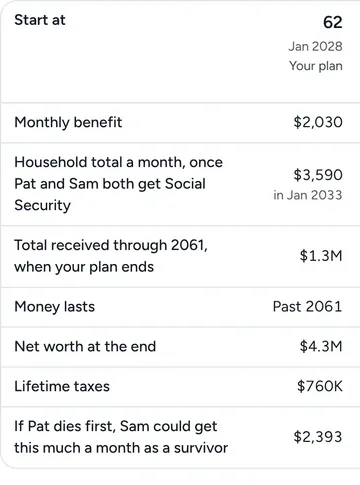
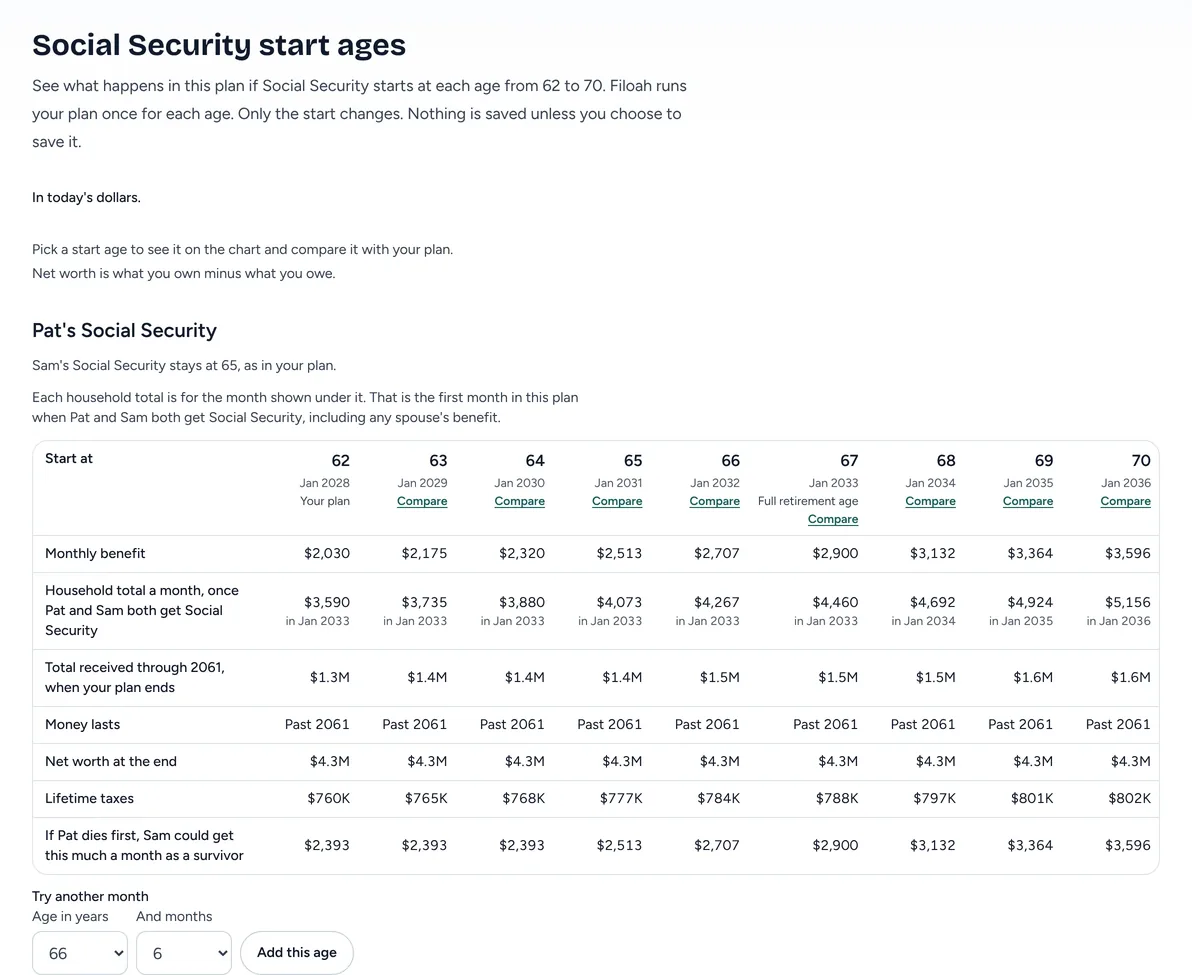
This screen runs one plan at each start age from 62 to 70.
What this does not include
- Filoah uses the amount you enter for your full retirement age. It uses the same amount for every start age, but more years of work can raise it.
- Filoah uses today's Social Security law. It does not guess at future changes to the law.
- It does not include benefits for a former spouse, for children, or for a disability.
- It does not take Medicare premiums out of the benefit.
- The break-even ages here leave out cost-of-living raises, taxes and investment returns.
- Social Security decides your real benefit. Your Statement shows your own estimate at each age.
Sources
Sources checked November 21, 2026.
Run this on your own plan.
Make a free plan with your accounts, your Social Security and your state’s taxes.
Free account. No card. No bank linking.
This article is for learning. It is not tax, legal or investment advice.