Connecticut taxes on retirement income (2026)
By the Filoah team · Last checked November 21, 2026 · Rules as of the 2026 tax year
The short answer
Connecticut's retirement tax rules are based on income, not age. If your federal adjusted gross income is under $75,000 (single) or $100,000 (joint), Connecticut does not tax your Social Security, pension, annuity, 401(k) or traditional IRA money. Above those lines, more of it is taxed, step by step.
Social Security
Social Security is fully exempt from Connecticut tax if your federal adjusted gross income is under:
- $75,000 on a single or married filing separately return
- $100,000 on a joint, head of household or qualifying surviving spouse return
Above that line, Connecticut taxes at most 25% of your benefits. This is a cliff: at $74,999 of income on a single return none of it is taxed, and at $75,000 some can be.
Pensions, 401(k) and IRA money
From 2026, Connecticut treats pensions, annuities, 401(k)-type plans and traditional IRA withdrawals the same way. There is no age test. A 55-year-old gets the same treatment as a 75-year-old.
Below the income line, all of it is left out of Connecticut income. Above the line, the share you can leave out drops in steps. For a joint return:
| Federal adjusted gross income | Share you can leave out |
|---|---|
| Under $100,000 | 100% |
| $100,000 to $104,999 | 85% |
| $105,000 to $109,999 | 70% |
| $110,000 to $114,999 | 55% |
| $115,000 to $119,999 | 40% |
| $120,000 to $124,999 | 25% |
| $125,000 to $129,999 | 10% |
| $130,000 to $139,999 | 5% |
| $140,000 to $149,999 | 2.5% |
| $150,000 or more | 0% |
A single return uses the same idea, starting at $75,000 and reaching 0% at $100,000. These lines are fixed in law and do not rise with inflation.
The steps are sharp. Here is a made-up couple filing jointly with a $60,000 pension. At $104,999 of income, they leave out 85%, which is $51,000. At $105,000, they leave out 70%, which is $42,000. One dollar more of income moved $9,000 into their Connecticut income.
A Roth conversion raises federal adjusted gross income. A large one can push a household past these lines for that year.
Other Connecticut rules
- Military retirement pay and Railroad Retirement are not taxed at any income.
- Half of a Connecticut teacher's pension is not taxed.
- Rates run from 2% to 6.99%. There is no standard deduction. The personal exemption shrinks as income rises.
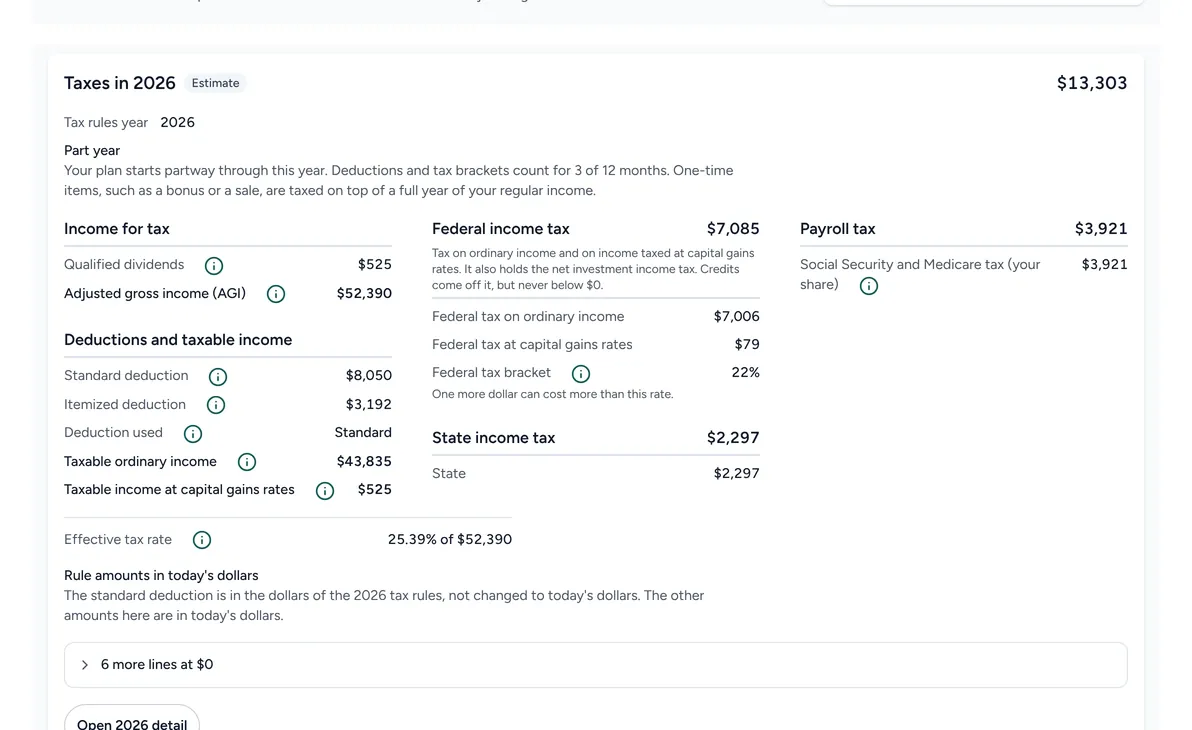
The sample couple in this picture lives in New Jersey. Your own plan shows the state you live in.
How Filoah does it
Filoah uses its 2026 tax rules. It applies the Social Security cliff and the pension and IRA step table to each year of your plan, along with federal tax, and shows Connecticut tax in the Taxes view.
The official source is the Connecticut Department of Revenue Services, at portal.ct.gov/drs.
What this does not include
- Filoah does not give the breaks for a teacher's pension, military retirement pay or Railroad Retirement. It taxes them like other pensions, which can show more tax than you owe.
- It does not count Connecticut's property tax credit, up to $300.
- Connecticut has not said whether a Roth conversion counts toward the pension and IRA break. Filoah lets it use the break, which can show less tax than you owe.
Sources
- Connecticut Department of Revenue Services, 2025 Form CT-1040 instructions
- Connecticut Department of Revenue Services, 2026 Form CT-1040ES
- Connecticut Department of Revenue Services, individual income tax forms
Sources checked November 21, 2026.
Run this on your own plan.
Make a free plan with your accounts, your Social Security and your state’s taxes.
Free account. No card. No bank linking.
This article is for learning. It is not tax, legal or investment advice.