Moving to another state in retirement: taxes
By the Filoah team · Last checked November 21, 2026 · Rules as of the 2026 tax year
The short answer
When you move to another state in retirement, the new state taxes your income as a resident from the day you move. Each state taxes Social Security, pensions and IRA withdrawals in its own way. Federal law stops your old state from taxing most pension and IRA income you receive after you leave. In the year of the move, you usually file a part-year return in both states.
What changes when you move
State income tax is where most of the change shows up. States differ on:
- Social Security. Many states do not tax it at all. Some tax part of it. In Filoah's 2026 tax rules, eight states can tax some Social Security benefits: Colorado, Connecticut, Minnesota, Montana, New Mexico, Rhode Island, Utah and Vermont. Connecticut, for one, does not tax it below an income line.
- Pensions and IRA withdrawals. Some states leave out a set dollar amount after a certain age. Some leave out all of it below an income line. Some tax all of it. A few have no income tax.
- Tax rates. Rates and brackets differ a lot. Some states have one flat rate.
- Local taxes. A few cities add their own income tax.
A made-up example. A couple, both over 59 and a half, takes $60,000 a year from their IRAs, $30,000 each. In New York, each can leave out $20,000, so $40,000 is left out and $20,000 counts toward New York income. In Florida, which has no state income tax, none of it is taxed by the state.
States also differ on property tax, sales tax and estate tax. Those are not income taxes, and they can matter as much.
Residency and domicile
A state taxes you as a resident if it is your domicile, or if you meet its rules for living there.
Domicile is the place you intend to be your permanent home, the place you return to after being away. You have only one. New York says a New York domicile does not change until you show you have left it and set up a new permanent home somewhere else, and that the change must be clear and convincing.
New York looks at five things to judge a change of domicile:
- the size, value and use of your old home compared with your new one;
- your work and business ties in each place;
- how much time you spend in each place;
- where you keep things of great personal value; and
- where your close family is.
Where you vote, where your driver's license is from, and where your will is kept are not primary factors in New York's test.
States can also treat you as a resident by time spent there. New York may treat you as a resident if you keep living quarters in the state for most of the year (more than 11 months) and spend 184 days or more there. Any part of a day counts as a day. New Jersey's chart asks whether you kept a permanent home there and spent more than 183 days there.
The year of the move
In the year you move, you are usually a part-year resident of both states.
- New York has a nonresident and part-year resident return, Form IT-203.
- New Jersey has no part-year return. You file Form NJ-1040 for the part of the year you lived there, and Form NJ-1040NR if you had New Jersey income while you lived elsewhere.
Each state taxes what you received while you lived there. The old state can still tax some income you get from it after you leave, such as wages for work done there or rent from property there.
Pensions and IRAs after you leave
A federal law, 4 U.S.C. section 114, bars states from taxing nonresidents on income from qualified pension plans and certain other retirement plans. New York's instructions say so in plain words. So once you have moved away, your old state generally cannot tax your IRA withdrawals or most pension payments.
This is why the timing of large taxable income around a move can matter. A large IRA withdrawal or a Roth conversion taken while you live in one state is taxed by that state. The same amount taken after you move is taxed by the new state instead.
Required minimum distributions work the same way. They are taxed by the state you live in when you take them.
Seeing a move in a Filoah plan
In a free Filoah plan, you can add a Move to another state life event. You pick the state, a locality when Filoah has a local tax there, and when the move happens. From that year on, the plan uses that state's tax rules. Filoah has state income tax rules for all 50 states and the District of Columbia.
Filoah taxes the whole year of the move in the state where you live on December 31 of that year. It does not split the year between two states. The Move to another state form says so before you save.
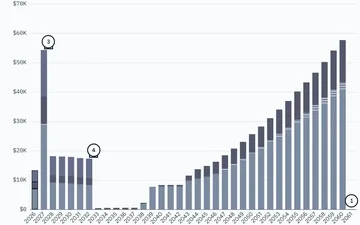
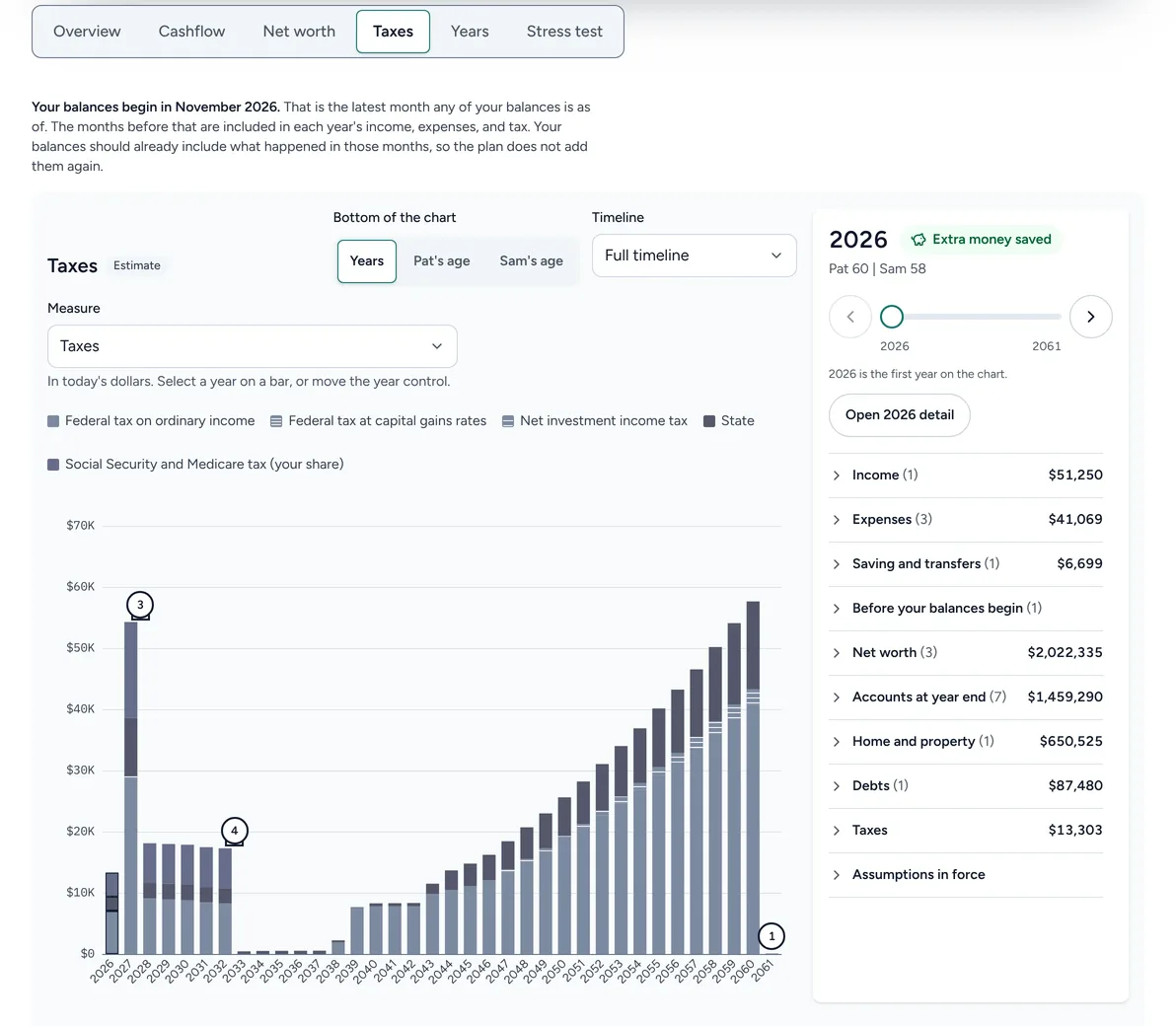
The sample couple in this picture lives in New Jersey. Your own plan shows the state you live in.
The Taxes view shows each year's estimated tax, so you can see the state tax change in the year the move takes effect.
Filoah does not add a moving cost on its own. You can add one as an expense in the year you move.
What this does not include
- Part-year state returns. Filoah uses the new state for the whole year of the move.
- Tax your old state can still charge on income from that state, such as wages or rent, after you leave.
- Credits a state gives for tax paid to another state.
- Property tax, sales tax and state estate or inheritance tax.
- Local income taxes other than New York City and Philadelphia.
- Some 2026 state figures not yet published. For several states, Filoah's rules carry some 2025 figures until the 2026 forms come out.
This page explains how state taxes change with a move. It is educational only and does not say where to live. Results in a plan are estimates, not promises.
Sources
- New York State, Instructions for Form IT-203 (2025), Nonresident and Part-Year Resident
- New York State, Instructions for Form IT-201 (2025)
- New Jersey, Instructions for Form NJ-1040 (2025)
- Connecticut DRS, Form CT-1040 Instructions (2025)
Sources checked November 21, 2026.
Run this on your own plan.
Make a free plan with your accounts, your Social Security and your state’s taxes.
Free account. No card. No bank linking.
This article is for learning. It is not tax, legal or investment advice.