New York taxes on retirement income (2026)
By the Filoah team · Last checked November 21, 2026 · Rules as of the 2026 tax year
The short answer
New York does not tax Social Security, and it does not tax pensions from New York State, New York local governments or the federal government. Other retirement income, such as a private pension, IRA or 401(k) money, is taxed, but each person 59 and a half or older can leave out up to $20,000 of it a year.
What New York does not tax
- Social Security. None of it is taxed by New York.
- Government pensions. A pension from New York State, a New York city or town, or the federal government, including military retirement pay, is not taxed, at any age. Railroad Retirement is not taxed either.
The $20,000 pension and annuity exclusion
New York lets each person 59 and a half or older leave out up to $20,000 a year of other retirement income. That covers:
- a private pension, or a pension from another state's government
- traditional IRA withdrawals
- 401(k), 403(b) and similar work plan withdrawals
- annuity payments from a job's plan
A few rules matter:
- It is per person. A married couple can leave out up to $40,000 together, but only if each spouse is 59 and a half or older and has at least $20,000 of this income in their own name. One spouse cannot use the other's unused part.
- The birthday year. In the year you turn 59 and a half, only payments after that date count.
- Roth conversions. A Roth conversion moves money from a traditional IRA to a Roth IRA. New York counts it as IRA income, so it can use the same $20,000.
How the rest is taxed
Income above the exclusion is taxed at New York's rates. For 2026 they run from 3.9% to 10.9%. The standard deduction (a set amount of income that is not taxed) is $8,000 for a single return and $16,050 for a joint return. These amounts are fixed in law and do not rise with inflation.
Once New York adjusted gross income passes $107,650, New York takes back the benefit of its lower rates, step by step. At higher incomes, all taxable income ends up taxed at your top rate.
New York City has its own income tax on top of the state tax for people who live there.
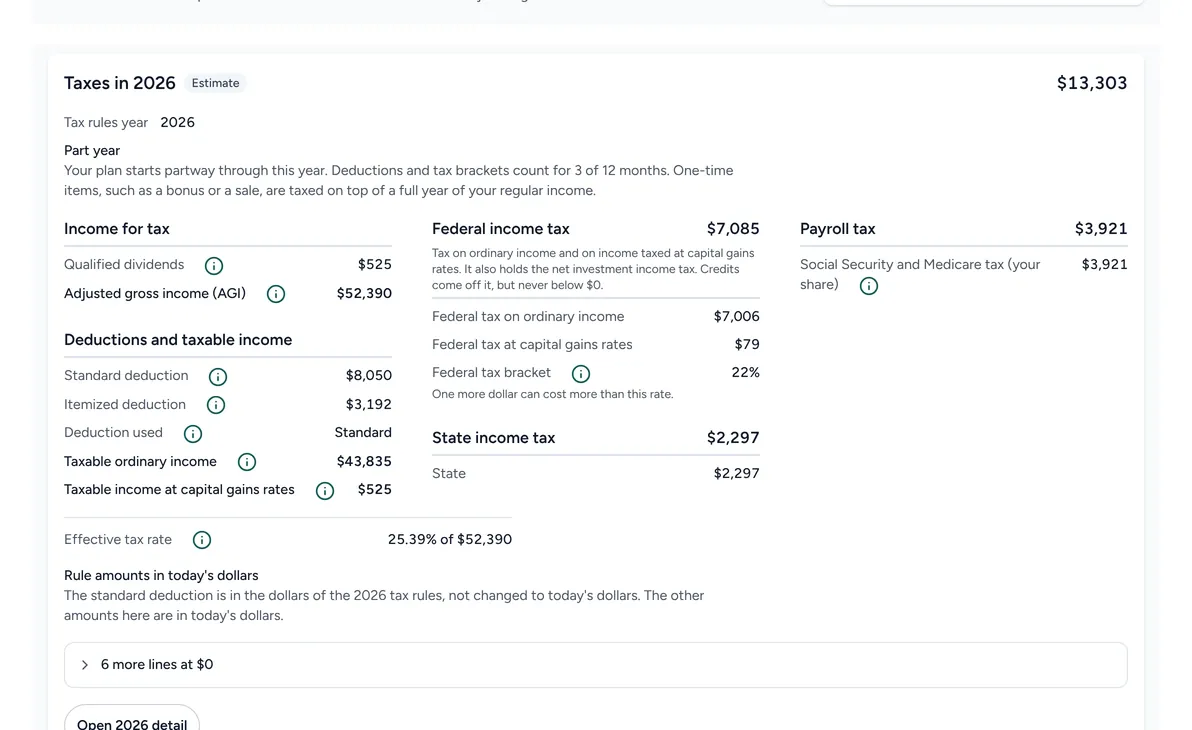
The sample couple in this picture lives in New Jersey. Your own plan shows the state you live in.
How Filoah does it
Filoah uses its 2026 tax rules. It applies the rules above to each year of your plan, along with federal tax, and shows New York tax in the Taxes view. It keeps the 2026 rates in later years.
The official source is the New York State Department of Taxation and Finance, at tax.ny.gov.
What this does not include
- Filoah cannot tell if your pension is from New York or the federal government, so it taxes it like other pensions. That can show more tax than you owe.
- It gives the $20,000 break on an annuity you bought yourself and on a lump sum from a 401(k), which New York may not.
- It does not let a person who inherits an account use the break of the person who died.
- It always uses the standard deduction. New York lets you list your costs instead.
- It does not use New York's tax tables, so its tax can be a few dollars off.
- It does not count the Yonkers city tax or the transit tax on some self-employed people.
- It does not change your income for interest from US government bonds or other states' bonds.
- New York passed a rate cut for 2027, and its three top rates are set to end after 2032. Filoah keeps the 2026 rates in every year.
- For New York City tax, Filoah gives one $20,000 pension break for the whole return at any age, and does not take a Roth conversion off city income.
Sources
- New York State Department of Taxation and Finance, Information for seniors
- New York State Department of Taxation and Finance, Instructions for Form IT-2105 (2026 estimated tax), with the 2026 rates
- New York State Department of Taxation and Finance, IT-201 instructions (2025) and tax tables
Sources checked November 21, 2026.
Run this on your own plan.
Make a free plan with your accounts, your Social Security and your state’s taxes.
Free account. No card. No bank linking.
This article is for learning. It is not tax, legal or investment advice.