New Jersey taxes on retirement income (2026)
By the Filoah team · Last checked November 21, 2026 · Rules as of the 2026 tax year
The short answer
New Jersey does not tax Social Security. Pension, IRA and 401(k) money is taxed. But a person 62 or older can leave out a large part of it, up to $100,000 on a joint return, as long as total income is $150,000 or less.
What New Jersey does not tax
Social Security and Railroad Retirement benefits are not taxed in New Jersey. They also do not count toward the income limits below.
The retirement income exclusion
New Jersey's pension exclusion lets you leave out pension, annuity and IRA withdrawals from your taxable income. To get it, you (or your spouse, on a joint return) must be 62 or older on the last day of the year, or disabled under Social Security rules. Your total New Jersey income must be $150,000 or less.
How much you can leave out depends on your income:
| Total income | Joint | Single, head of household, qualifying widow(er) | Married filing separately |
|---|---|---|---|
| Up to $100,000 | up to $100,000 | up to $75,000 | up to $50,000 |
| $100,001 to $125,000 | 50% of pension income | 37.5% | 25% |
| $125,001 to $150,000 | 25% of pension income | 18.75% | 12.5% |
| Over $150,000 | none | none | none |
These are cliffs, not slopes. Here is a made-up couple filing jointly, both over 62, with a $60,000 pension. With total income of $100,000, they can leave out all $60,000. With total income of $100,001, they can leave out 50%, which is $30,000. One more dollar of income moved $30,000 back into their taxable income.
A few more rules:
- One cap per return. Spouses do not each get a cap.
- Only the qualifying spouse's money. If one spouse is 62 and the other is not, only the older spouse's pension and IRA money can be left out.
- Everything else counts toward the limit. Wages, interest, dividends, capital gains, IRA withdrawals and a Roth conversion all raise total income. Social Security does not.
How the rest is taxed
New Jersey has no standard deduction. Each filer gets a $1,000 exemption, plus $1,000 more at 65 or older. Rates run from 1.4% to 10.75%.
How Filoah does it
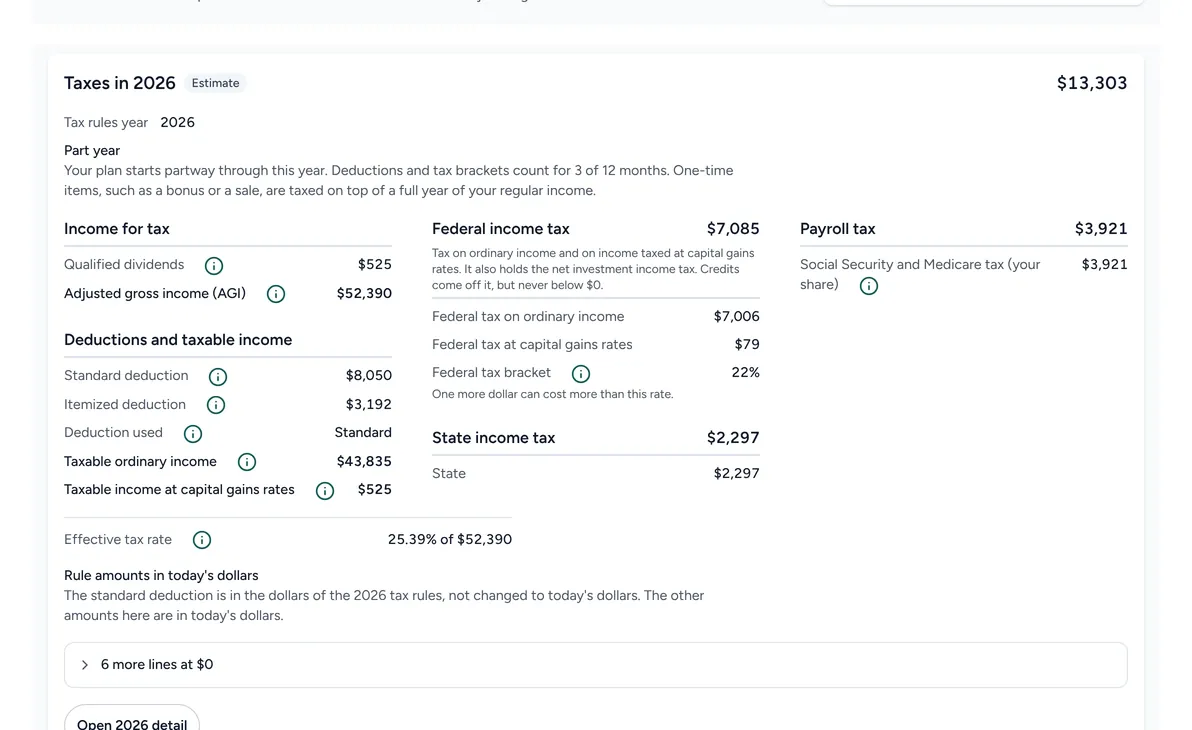
Filoah uses its 2026 tax rules. It applies the exclusion, its age test, its income bands and its cliffs to each year of your plan, along with federal tax, and shows New Jersey tax in the Taxes view.
The official source is the New Jersey Division of Taxation, at nj.gov/treasury/taxation.
What this does not include
- Part of a pension or IRA payment can be money you already paid tax on. New Jersey does not tax that part. Filoah taxes it.
- If you are 62 or older and earn little from work, New Jersey lets you leave out more of your other income. Filoah does not count that.
- Filoah does not count New Jersey's property tax deduction or credit.
- It does not give the exclusion to a person under 62 on Social Security disability.
- New Jersey has not said if a Roth conversion counts for the exclusion. If you do one, Filoah lets it use the exclusion, which can show less tax than you owe.
- It does not tax pay put into a 403(b), 457, SEP or the federal workers' savings plan, which New Jersey does tax.
- It adds money put into a health savings account to New Jersey income. No New Jersey rule we found says this, so it is a guess.
- It gives the $1,000 exemption only to a person you mark as blind, not to a person who is disabled, and it leaves out the $6,000 veteran exemption.
Sources
- New Jersey Division of Taxation, Retirement Income Exclusions
- New Jersey Division of Taxation, NJ Income Tax: Retirement Income
- New Jersey Division of Taxation, GIT-1 and 2: Retirement Income
Sources checked November 21, 2026.
Run this on your own plan.
Make a free plan with your accounts, your Social Security and your state’s taxes.
Free account. No card. No bank linking.
This article is for learning. It is not tax, legal or investment advice.