The 4% rule, tested against market history since 1871
By the Filoah team · Last checked November 21, 2026 · Rules as of the 2026 tax year
The short answer
The 4% rule says you can take 4% of your savings in the first year of retirement, then raise that dollar amount with inflation each year. In Filoah's test against US market history, a 4% start lasted 30 years in 125 of 126 past periods, with 75% stocks and 25% bonds. That is a record of the past, not a promise about the future.
What the 4% rule is
The 4% rule is a rule of thumb for spending from savings. It has two steps.
- In year one, take 4% of what you have saved. With $1,000,000, that is $40,000.
- Each year after, take last year's amount plus inflation (the rise in prices). If prices went up 3%, the $40,000 becomes $41,200.
The amount does not change when markets go up or down. Only inflation moves it. In Filoah this spending method is called constant dollar.
How we tested it
Filoah's stress test has a method called Past markets. It runs your plan through real US market history, one period for each start year, with the years that followed in the order they happened. The data starts in 1871 and runs through 2025. For a 30-year retirement, that gives 126 periods. The first starts in 1871 and the last starts in 1996.
The test setup:
- $1,000,000 to start, $40,000 in year one, raised with inflation
- 30 years
- 75% US stocks and 25% US bonds, rebalanced back to that mix each year
- No taxes and no fees
- Each year's amount paid in 12 monthly steps
What the history shows
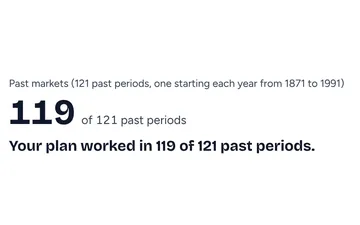
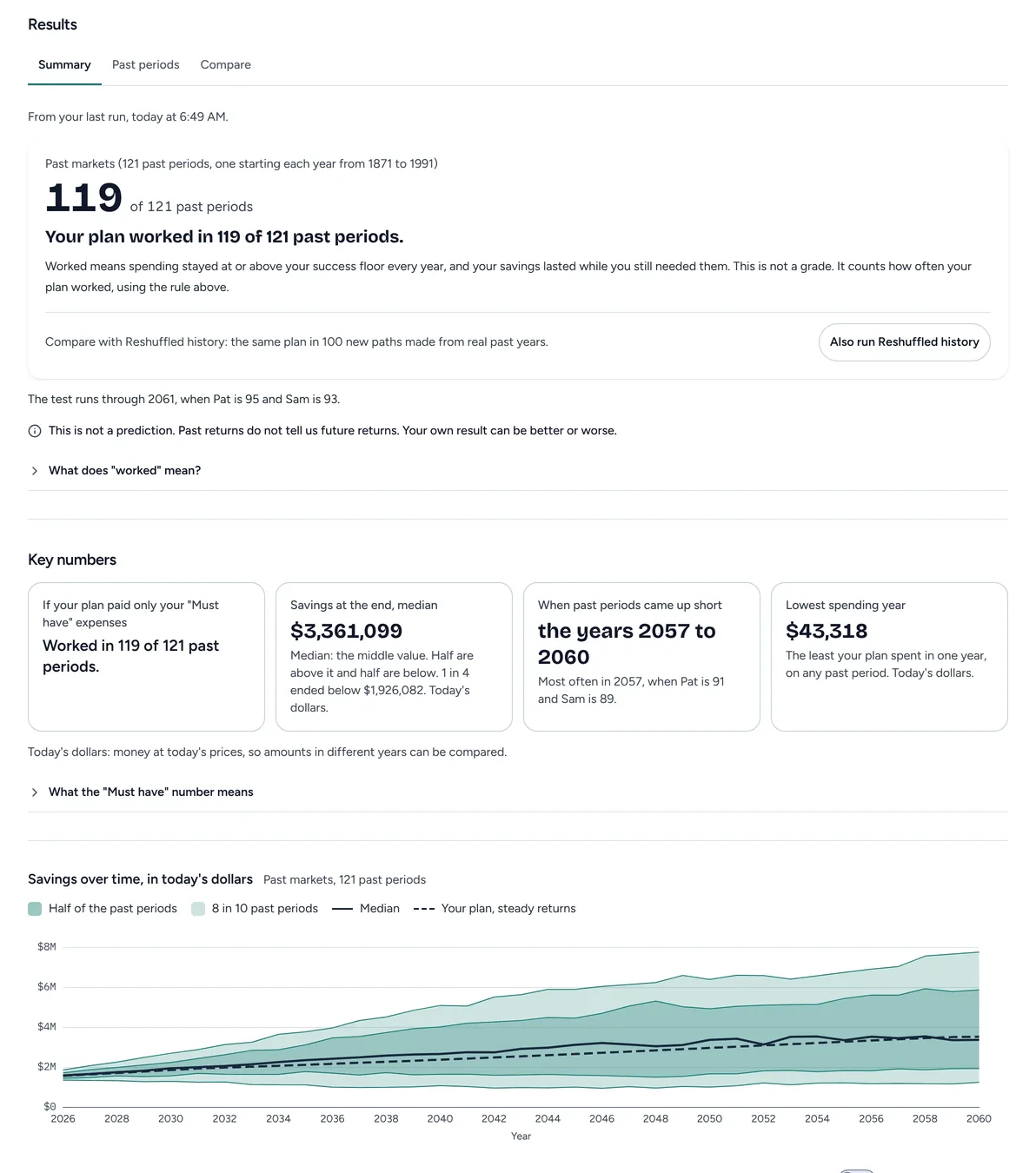
With that setup, the plan worked in 125 of 126 past periods. The one that ran out started in 1966. Its savings ran out in year 29.
Fees matter too. With a 0.18% yearly fee taken off returns, the count drops to 124 of 126. The 1965 start runs out as well.
Here is how the count changes with the rate and the mix. Each cell is the number of 30-year periods, out of 126, where the money lasted. No fees and no taxes.
| First-year rate | 100% stocks | 75% stocks, 25% bonds | 50% stocks, 50% bonds |
|---|---|---|---|
| 3% | 126 | 126 | 126 |
| 3.5% | 126 | 126 | 126 |
| 4% | 124 | 125 | 124 |
| 4.5% | 118 | 118 | 112 |
| 5% | 107 | 104 | 92 |
| 5.5% | 100 | 94 | 74 |
| 6% | 90 | 82 | 68 |
Two things stand out. First, small changes in the rate make a big difference. Going from 4% to 5% takes the 75/25 mix from 125 to 104. Second, the periods that fail are bunched together. At 4.5% with 75/25, the failures started in 1906, in each year from 1964 to 1969, and in 1973. The 1960s starts ran into years of high prices. From 1966, inflation averaged about 5.8% a year over the next 10 years.
Results are estimates, not promises. Past markets do not predict future ones.
Why the rule is not a law
The 4% rule comes from looking back at history. That is useful, but it has limits.
- One country. These figures are US markets only. The test does not include any other country's markets.
- Few true periods. The 126 periods overlap a lot. The 1965 and 1966 periods share 29 of their 30 years. So there are fewer separate tests than the count makes it look.
- Fixed spending. Real people often spend less in bad years, or more in good ones. The rule assumes you never change.
- No taxes. Money from a traditional IRA or 401(k) is generally taxed when you take it out. If taxes come out of the same savings, more has to come out to pay them.
- 30 years only. A person who stops work at 55 may need money for 40 years or more. A longer time is a harder test.
Test your own rate
The quick test starts with Reshuffled history. It makes 100 new paths by drawing real past years in random chunks, from 1871 to 2025. To see every past period in order, the way the table above was made, switch the method to Past markets. The test also starts with a 0.10% yearly fee, and you can change it.
A path counts as worked when your spending stayed at or above your success floor every year, and your savings lasted while you still needed them. The success floor starts at 75% of what you spend.
What this does not include
- The table above has no taxes and no fees. Both lower the counts.
- It uses US stocks and US government bonds only (10-year US Treasury bonds from 1953 on). It does not use other bonds, other countries or real estate.
- The quick test treats your savings as one account, with no 401(k), IRA or Roth rules, and no required minimum distributions.
- It adds no Medicare or health insurance costs, and no long-term care.
- It does not estimate Social Security or pensions. It uses the amounts you type.
- It runs for the years you pick. It does not guess how long you will live.
Sources
Sources checked November 21, 2026.
Test your own numbers.
The free Retirement Stress Test runs your savings and spending through market history since 1871. No account needed.
This article is for learning. It is not tax, legal or investment advice.